The Problem of Mary Carter’s Portrait.
In his 1810 Memoirs, William Hickey described Mary Carter as “a smart and rather good-looking girl.” She certainly had a profound effect on the men in Keppel Craven's circle; Sir William Gell was utterly devoted to her, and years later, former family servants said that, in her youth, Mary had been "a small, pretty girl." Yet despite all these assurances of her appeal and beauty, no securely identified portrait of her is known.
This hasn’t stopped me from trying to locate one.
My first clue was found in Keppel Craven’s journal. In 1827, he noted sitting twice for an unnamed artist at Paris. His lover, Andrea Pasquini, also sat twice. Then, on the fifth visit, Keppel wrote, “Go to painter and see Lady Craven and her son &c and get my picture finished.” The entry clearly refers to Keppel’s own portrait, but the presence of “Lady Craven and her son” suggested that more than Keppel and Pasquini may have been involved in these sittings. Keppel often used proxies in his journal for Mary’s activities (with “Lady Craven” possibly being one), and I had no way of knowing who had really sat for what. I had only a date and a location.
Fortunately, I knew exactly where Andrea Pasquini’s portrait had ended up.
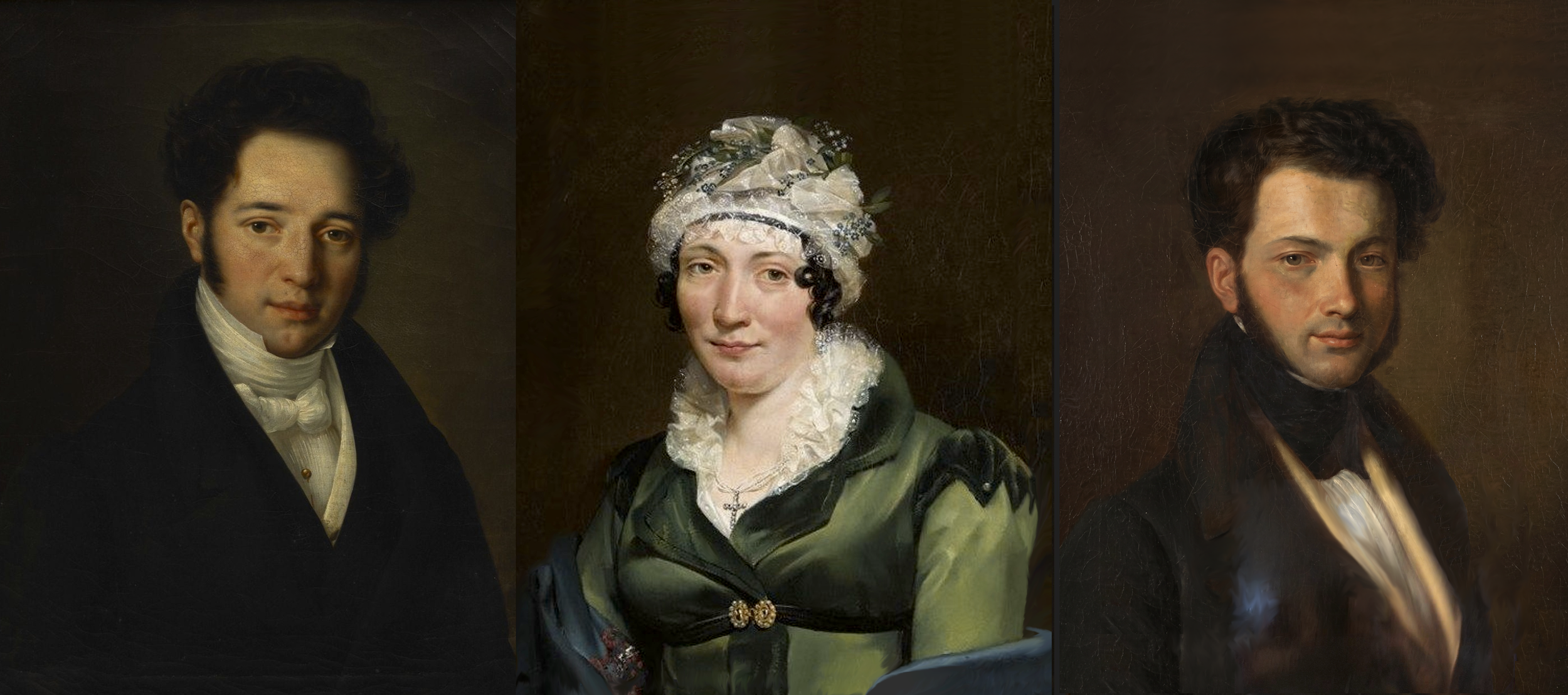
Pictured above: Keppel Craven and Andrea Pasquini by Jean-Joseph Vaudechamp, 1828, and Portrait of a Woman by Henri Grévedon, date unknown. Pasquini portrait reconstructed via AI from poor photographs of original painting. Grévedon picture photoshopped to how it may have appeared before being cut down. For originals of all three portraits, see biography pages.
Keppel’s beloved secretary inherited half of his fortune and his country house near Naples. That house, the former monastery of Sant’Andrea, still belongs to Pasquini’s descendants today, and on the wall there, hanging for nearly two hundred years, is the picture believed to have been painted at Paris. It is not signed or dated. The sitter is not named. Yet we can determine his identity from a drawing in Keppel’s travel journal. When no one but Mary, Pasquini and servants accompanied him to Paris, Keppel sketched someone sleeping in the carriage beside him. The young gentleman has the same upturned nose and the same beauty as the man in the oil painting. He is very obviously Pasquini, and the black cravat he wears is consistent with the late 1820s.
If the portrait of Pasquini had been painted at Paris, I reasoned that I might use it to determine the artist. How naïve I was, to think this would be easy! I looked at hundreds and hundreds of similar pictures. The refined brushwork and olive-brown background were common features of portraits from the period. Nevertheless, after an exhaustive search, I stumbled upon a painting that, at first glance, seemed familiar.
Imagine my surprise when I realized I was looking at Keppel Craven.
The portrait does not idealize his handsomeness. Keppel’s nose was quite pronounced at the age of forty-eight. His eyes were less beautiful than they had appeared in his youth when he and his brother had sat to John Hoppner. His cheeks were pudgier than in the d’Orsay sketch of 1832, and yet his gaze, direct and amiable, spoke to me as I stared at the picture.
The strongest corroborating detail was the hair brushed forward at the temple, complete with a little cowlick above—exactly as Sir William Gell had drawn him six months later—as well as the amber color of his eyes and the gravity-defying quality of his curls. That hair, painted against a background of olive, also helped identify Pasquini’s artist. The two men’s portraits are handled in much the same way. Unlike Pasquini’s picture, however, Keppel’s was signed and dated: Jean-Joseph Vaudechamp, 1828.
The date may indicate that Vaudechamp completed the paintings after the 1827 sittings. The journal does not tell us exactly when they were finished, only that Keppel seems not to have received them at Naples until late 1828, when he and Pasquini unboxed the shipment, varnished the pictures and had them framed and hung in his drawing room on Chiatamone.
But what about Mary’s likeness? Had Keppel really neglected to have her painted? I didn’t think so. I therefore went back to the internet. I soon discovered that Vaudechamp, who had portrayed Keppel and Pasquini with such realism and individuality, usually treated women differently. His female portraits seem to possess individual faces, but these are pasted upon bodies that are clearly all the same: with elongated necks and sloping shoulders, they are all quite literally the same figure over and over, a model who stood in after the sitters were long gone.
Why would Keppel want a picture that wasn’t a true likeness? It seemed possible that, if Mary had sat at Paris, she and Keppel would have preferred a different artist who would paint her as herself. So finding no female portrait by Vaudechamp that matched Keppel’s and Pasquini’s in size, color and individuality, I began looking at other artists. Again, hundreds of pictures were perused. I was searching for a portrait that might have been designed to hang alongside theirs—a possible companion piece with similar dimensions, composition and background tone, even if executed by a different hand. Eventually, I came across a picture by Henri Grévedon—another French painter working in 1827—and once again the portrait spoke to me.
The picture is not signed or dated. The lady’s clothes have been catalogued as 1810s fashion, but her face is not young. Rather, she is middle-aged and pretty; her green dress and flowered cap could easily be those of a sensible older woman—which Mary was—and she wears a necklace of pearls.
The pearls reminded me of a cryptic 1830 letter in which Keppel arranged for pearls to be conveyed to England, to be left at Child’s bank until his son could retrieve them—for whom, he doesn’t say. The letter is typical of Keppel’s manner when referring to private matters: vague and mysterious, with the meaning known only to himself and the recipient. Nevertheless, pearls do not prove that the Grévedon portrait is Mary.
Probably nothing will.
Even so, I noticed that the lady’s olive-colored background resembled those in Keppel’s and Pasquini’s portraits. Her picture was smaller, and strangely, her left shoulder disappeared out of frame. On further digging, I discovered that the picture had once been displayed in an oval frame. When I adjusted the two images to the same apparent head scale, the missing space around the woman’s body suggested that the original dimensions may have been considerably larger. In its original form, the picture might have been much closer in size and presentation to Keppel’s—as if the two had been intended to hang as husband and wife.
I wrote to the museum in Dijon, which owns the portrait. I am still waiting for a response, but I suspect that the woman’s picture may have been cut down to fit in that oval frame, probably sometime in the nineteenth century.
If this portrait were Mary’s, one possible route into France would have been through Pauline de la Ferronnays. Pauline inherited Keppel’s papers and possessions, and after her death, her estate passed to her nephew, the Count de Mun. From there, at some point before 1923, much was sold. The Grévedon picture, if Mary, remained in France. Lord knows how Keppel’s portrait made its way to Michigan, but it did, where it was sold at auction in early 2026.
For the purposes of my research, and to display on my website, I lamented the fact that I had access to so many likenesses of Keppel, but only one possible candidate for Mary—and no way to prove it was her. So, on a whim, I decided to look further at portraits from the early nineteenth century, just in case I had missed another possible match…and I stumbled upon a portrait miniature for sale in France.
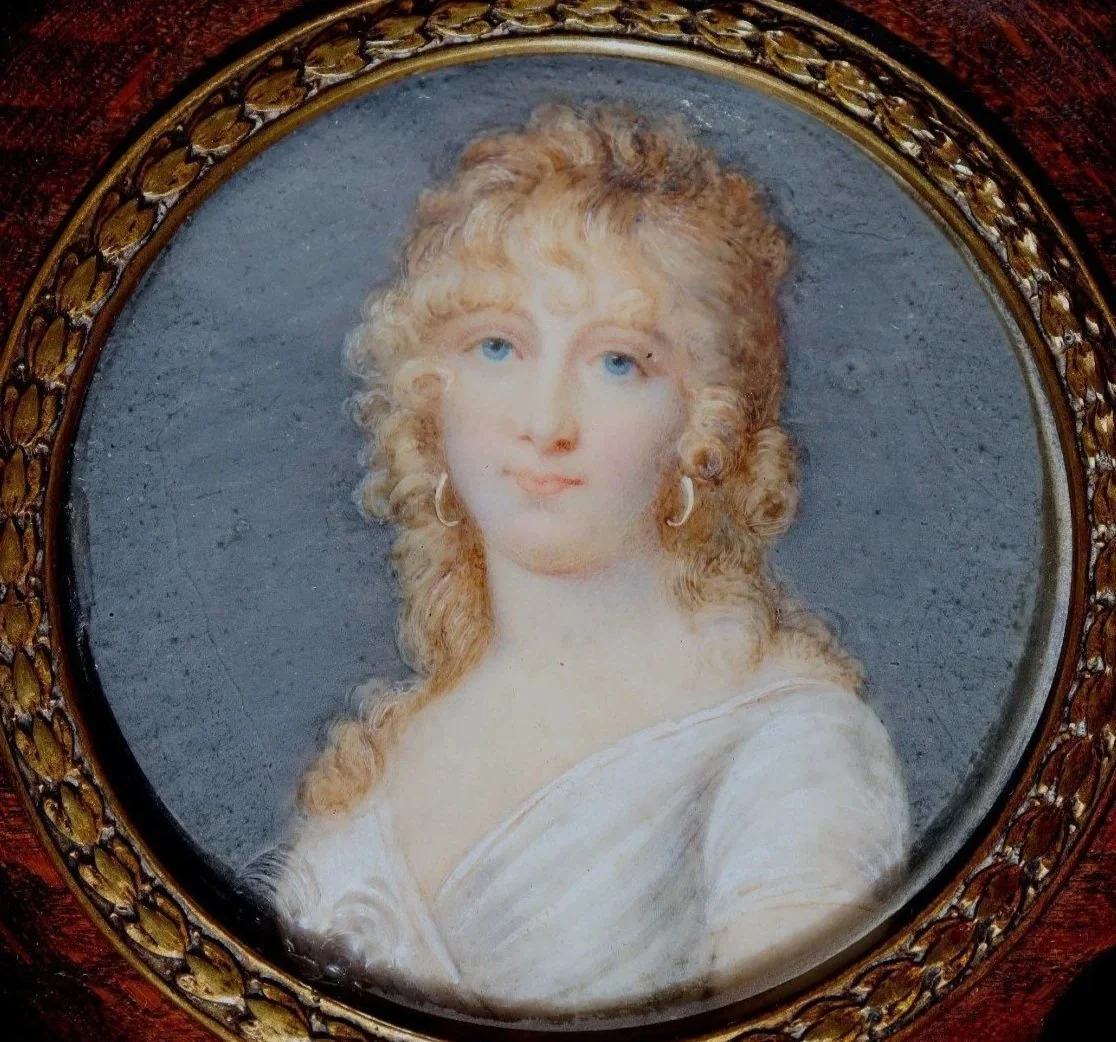
Portrait miniature, sitter, artist and date unknown, photo courtesy of Galerie Lhoste, Pau, France.
The face looks remarkably like that of the woman in the Grévedon portrait. Her chin is a little heavy; her lips are distinctive; her nose is straight and fine, her eyes blue, her tresses blonde, although I have reason to suspect from Keppel’s journal that Mary may have been darkening her hair by 1827. The blonde portrait was earlier, painted sometime between about 1795 and 1815. The woman’s dress is romantic and her hair is down. It could reflect the French Empire style of the late 1790s, or it might have been a romantic answer to the miniature Keppel had had painted for Mary in 1809, in which he wears an open collar, a green cloak, and poses before a stormy sky, complete with lightning.
Once again, we cannot prove that this woman was Mary. The miniature is unsigned and undated.
Wishing to purchase it, I wrote to the French dealer, hoping at least to use it on my website, which they kindly allowed me to do. But the picture is painted on ivory, and it would be illegal to import it into the United States. So having had this second possible portrait escape me, I went back one last time to searching.
And I found another miniature, identical to the first. Can you imagine the serendipity?
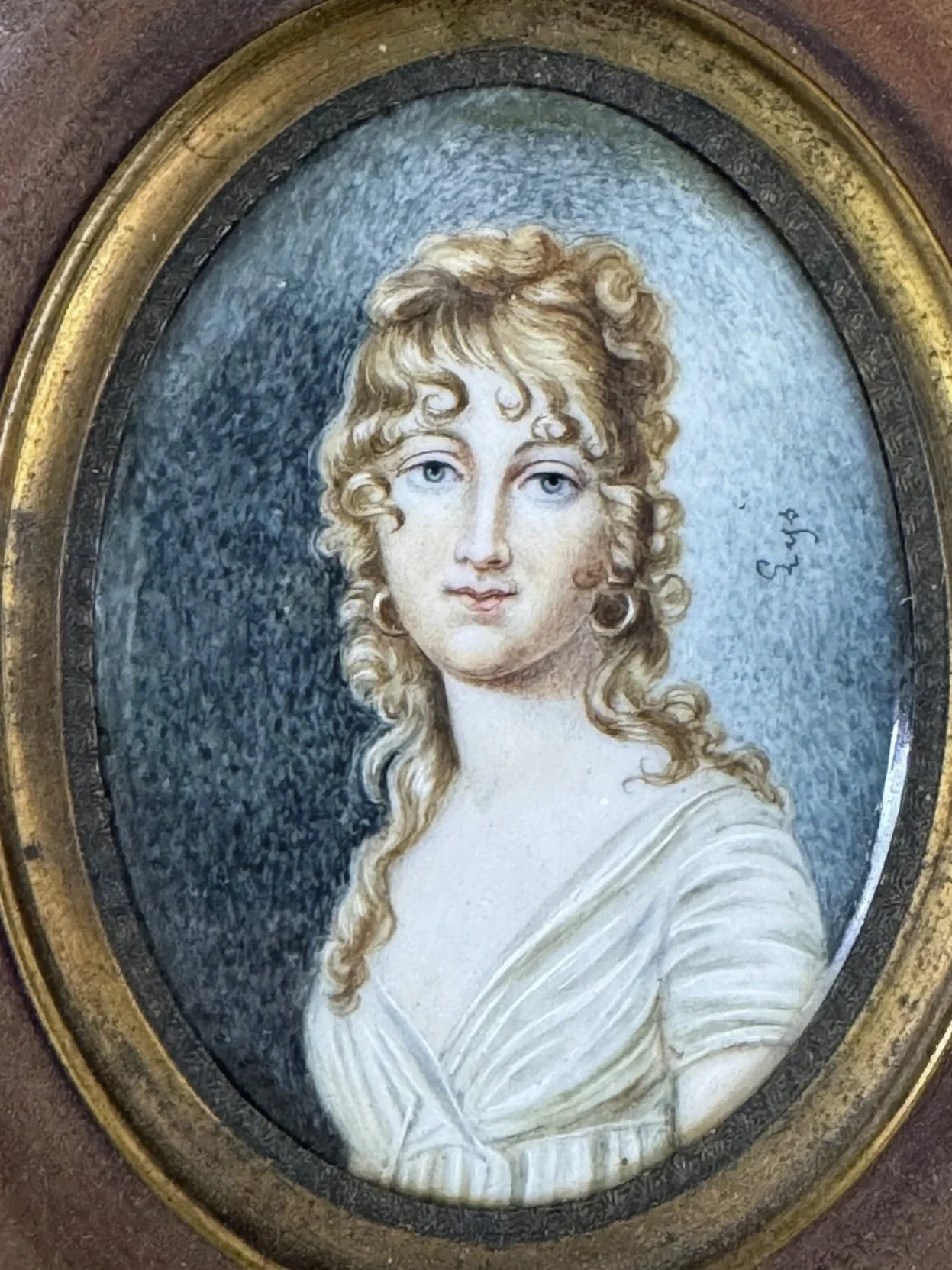
Portrait miniature copy.
This copy, by a different artist, was also French. Its sitter is identical in face, clothes and jewellery. Its backing consists of French eighteenth-century legal paper, and it may also be painted on ivory like the first—which was less of a problem, given that I discovered the dealer lived only two hours from me. Consequently, I now own the second miniature.
I cannot prove that it is Mary, but I like to think it is. Nor can I yet prove when the copy was painted. To my eye, its style appears much earlier than its mid-nineteenth-century frame, although the support and paint would need to be examined professionally before anything definite could be said. Still, the existence of two nearly identical versions raises an intriguing question. Why was a copy made instead of the woman simply sitting for another portrait? The explanation I came up with is fantasy, admittedly. But it is possible.
The novelist in me imagines Keppel Craven, angry with Mary (as he was in 1811), leaving the original portrait miniature in London as he and Sir William Gell prepared to travel to Greece. Gell—who was not angry with Mary—might have wanted to bring her likeness with him, for who knew if he’d ever see her again? Gell loved Mary Carter. I envision him carrying the little copy miniature in his pocket as he traveled across archaeological sites, taking bearings and making sketches, all while missing Mary in London.
It is a romantic idea. There is no way to prove it.
That is the trouble with Mary Carter’s portrait. She and Keppel spent much of their lives obscuring their association. Keppel frequently disguised Mary’s identity in his journal or recorded her activities indirectly. This may help explain why his references to the Paris sittings are so maddeningly unclear. But secrecy may not be the whole explanation. Portraits also lose their names through inheritance, reframing, sale and simple neglect. Somewhere among the many unidentified women of the period, Mary’s likeness may still survive.
Perhaps she is the woman in green at Dijon. Perhaps she is the blonde woman in the two miniatures. Perhaps she is all three, or neither. For now, I have candidates rather than an identification.
Which is why I shall probably never get a definitive answer about Mary’s picture.