How to Erase One’s Mistress from History.
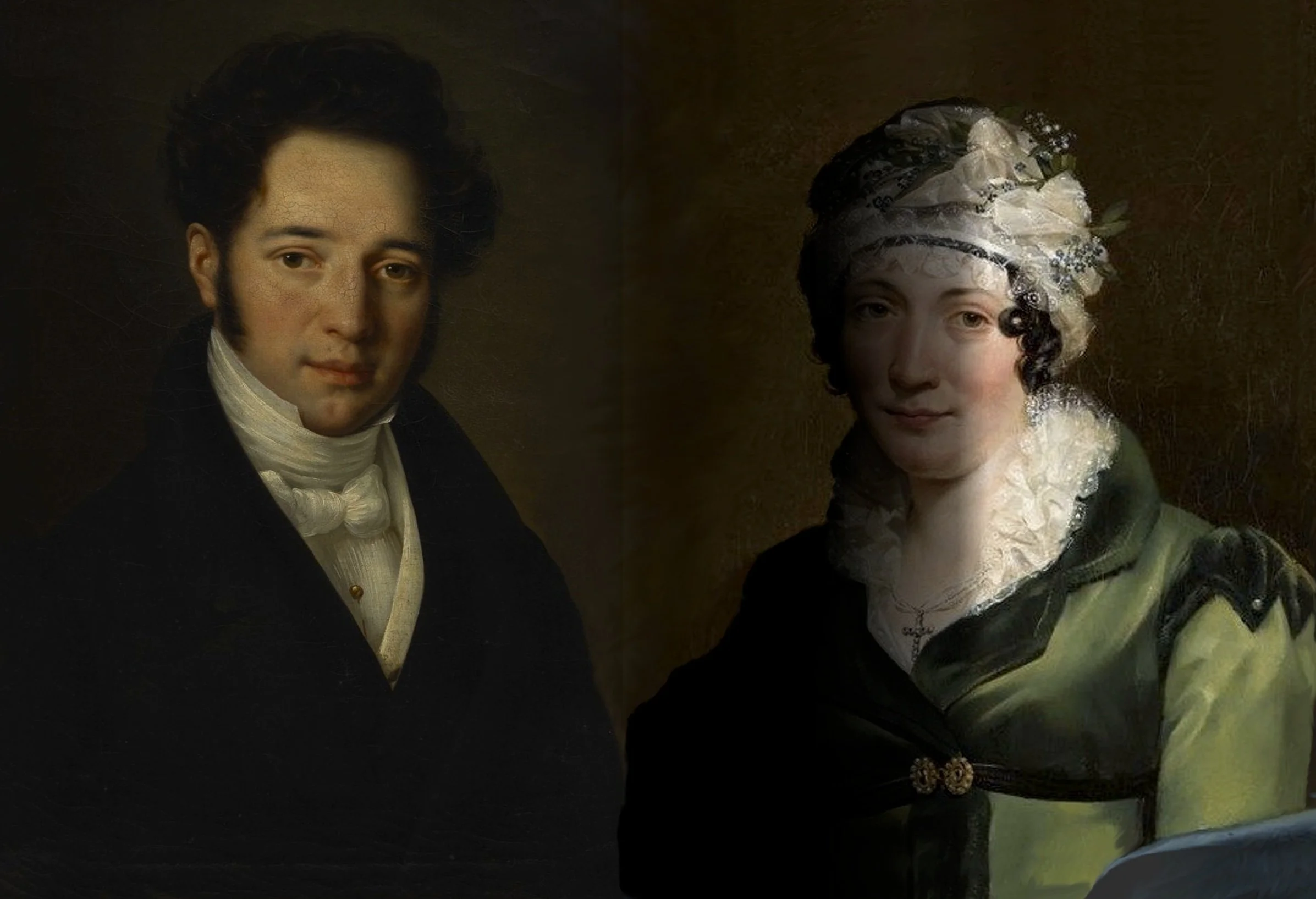
If you believe Keppel Craven and all his acquaintance, he was a lifelong bachelor. He wanted you to think this. Mr Craven was well aware of his visibility, for as the son of the scandalous Margravine of Anspach, everyone knew him. Even in his youth, he was recognized. In his teens, he frequently acted plays before royalty, which only raised his public profile. He was in the newspapers often in his twenties, whether reported to have danced at a ball, written a farce, or suffered some indisposition.
By the time he’d decided to spend his life with Mary Carter, he understood that he had no privacy, at least not without significant effort. If his letters weren’t hand-carried by a trusted servant, he assumed they were read. He’d seen journals published, probably against the wishes of their deceased authors, with private moments broadcast for all to read.
Presumably neither he nor Mary wanted this fate for themselves.
So when Mary’s brother forbade her from marrying (threatening to take her children away if she did) and Keppel found himself unable to make Mary respectable, the alternative was not what either of them would’ve liked—secrecy.
In the nineteenth century, a woman couldn’t live openly with a man outside of marriage. It was social suicide. It would have ruined Mary’s family, if anyone had known. Therefore, she found her existence suddenly divided. The Wells clan (save for Mary’s sisters and children) would believe she had moved to some faraway place. The Cravens, meanwhile, would accept her privately…and never the twain shall meet.
One imagines, from then on, that their society was divided into two camps: those unknown or untrusted who, at any party or dinner, were simply not introduced to Mary Carter, and thus correctly inferred that she was too scandalous to know (so no mention was ever made of her); and those in Keppel Craven’s innermost circle who eventually welcomed her, so much his siblings loved him, and so desperate was his mother not to be cut from his life. Among the latter group, too, was the Princess of Wales, whose inclusion of Mary probably went a long way towards establishing her at Naples. Being one of the first there after Murat’s fall, Mary preceded nearly every Englishwoman in the city. Because British travelers to Italy adored both Keppel and Gell, they maintained a polite silence regarding the unnamed woman with them.
Keppel himself seems to have been intensely aware of women’s reputations, so it’s not surprising how careful he was. He never wrote her name except during times of extreme emotion. Yet we know Mary was there. Patterns in his journal across forty-five years reveal obvious proxies for her illnesses and activities. Lady Charlotte Lindsay—Mary’s friend—was not so careful in her correspondence with Sir William Gell, and hints at three unnamed women fighting over Mr Craven in 1811 in “the girly game”: Mary, Lady Oxford and the Princess of Wales. Then there is the letter M, hidden in doodles, written inexplicably in the margins, across decades. No other person’s initial recurs in this peculiar, concealed fashion throughout the journals. Furthermore, Keppel’s penchant for threesomes (with a woman and various men) seems to have been regularly indulged from 1805 to at least late 1829; the constant, convenient presence of an unnamed lady strongly points to Mary.
Indeed, because Keppel was nearly always with her, this goes a long way towards explaining the lack of awareness in society of his sexual relationship with Sir William Gell. Mary acted the beard for them. The novelist Anna Maria Porter, who was smitten with him, even wrote in 1809 of Keppel, “(He) makes his eulogium every day with as much ardour as if he were a woman in love with (Gell).” Still she never suspected it was actually true, that Keppel was in love with his “inseparable friend.”
One supposes this cover worked in both directions. For Mary to be seen so conspicuously and intimately involved with two men—without any known marriage—made her dangerous for any proper lady to associate with. Still, Keppel and Gell were the people to know at Naples. Both were handsome and amiable. Everyone loved them, so Mary was tolerated…and no one said a thing.
It is very obvious that, over forty-five years, many letters between Keppel and his friends are now lost. This was on purpose. His papers (in their entirety) were inherited by Augustus Craven, then by Pauline de la Ferronnays; there is a huge trove of them at the Catholic Institute at Paris. Yet in that collection, and among Gell’s papers at the British Library (where most of those inherited separately by Keppel’s secretary ended up), there are only two letters between Keppel and Gell. All the rest must have been destroyed, whether weeded out after Keppel’s death, or as part of a pact between them…and we know from Keppel’s journal there were hundreds of letters. Surely Mary’s met the same fate. We know she wrote some because part of Keppel’s code was to use a penciled X in the margins to denote letters from women he wished to keep secret. Mary Carter and the Princess of Wales were two of them.
So what does one do to make one’s mistress disappear from history? Never refer to her, and ask your friends never to do so; never introduce her to anyone you don’t trust; use proxies for her when you can’t avoid mentioning her, e.g. write “quite torture” about a bad tooth keeping you awake all night when it is really your mistress weeping over her son, who has just died; earn the love and empathy of everyone you meet, especially those who distribute passports or record legal information, and possess enough money to bribe everyone else; when you must introduce your mistress to strangers, use a pseudonym for her; instruct her close family to lie and say she’s in Wales when really she is in Italy with you; and after you die, make sure there is no trace of your mistress in your will, because it will be published. Obituarists and biographers will write “lifelong bachelor,” because, in their eyes, it will be true—she was only a mistress. Later writers will mistake this for there being no woman at all.
Thus Mary’s disappearance required more than Keppel’s silence. It depended upon the discretion of an entire circle: relatives, servants, lovers, friends and heirs, all of whom were loyal to Mr Craven.
The only mention of Mary Carter’s identity appears in Keppel’s journals. He wrote it three times. In the first instance, he proposed elopement to a woman who had sailed to the island of Zante in February, 1813. He called her his “conquest.” Her initials were M.A.C. He wrote cryptically of her, “achieved an undertaking.” Then in the few days she was on the island—if you believe his journal—Keppel managed to do nothing but walk with her. Yet he was ready to spend the rest of his life with her. This is surprising, given that, whatever woman he married, she would have to tolerate his affairs with men.
Supposedly she sailed away in only a few days. There was a chaplain to the local garrison, so a marriage could have been legally performed, but apparently, whoever M.A.C. was, she said no.
Notwithstanding, later that year on New Year’s Eve in the Pavilion of his mother’s house at Hammersmith, Keppel wrote “conquer Mary” in his journal—a seeming reference to his “conquest” earlier in the year—followed soon after by another heavily stylized instance of the name. I can only guess Mary had decided to defy her brother and marry.
After that, she disappears again. The woman remained; only the name was removed, and later historians mistook that silence for absence.