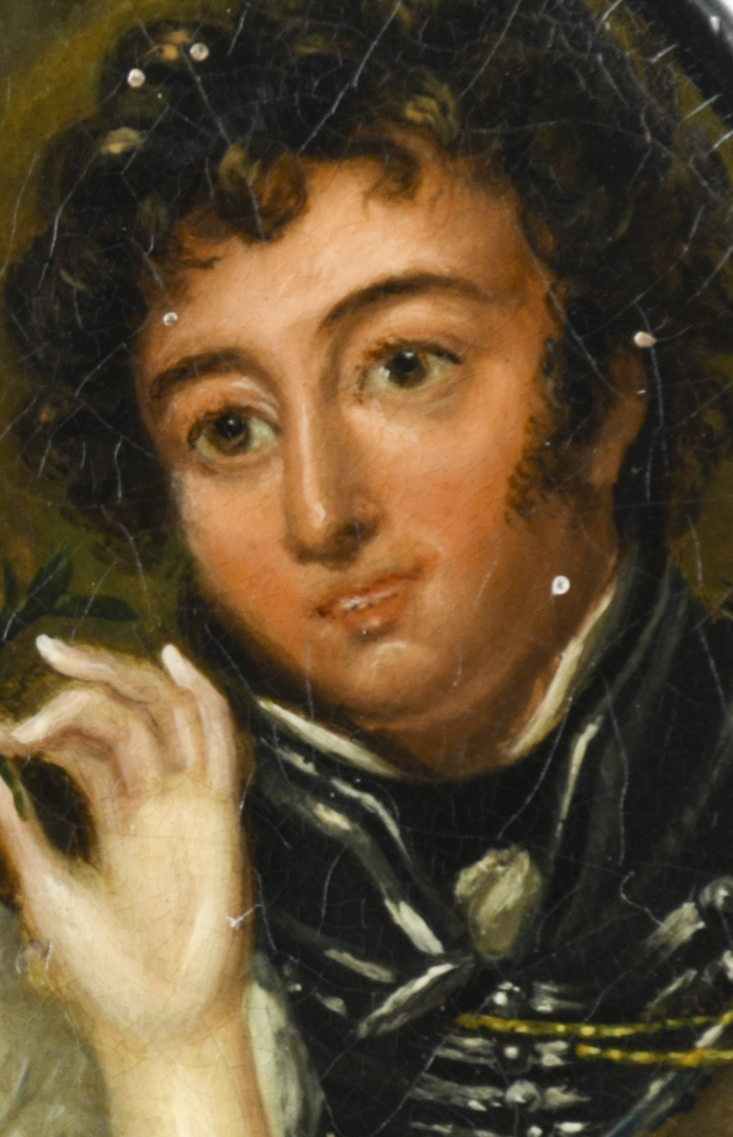
Detail from a Samuel Raven snuff box supposedly depicting Captain Charles Hesse, sold by Cheffins in 2021.
Charles Hesse — Officer in the 18th Light Dragoons, Equerry, brother of Keppel Craven.
Charles Hesse was born in or about 1791, officially the son of a Prussian merchant or banker of Berlin. That was the respectable version. Society preferred better gossip. Some said he was the natural son of the Duke of York, and that he was brought up at Oatlands. Lady Blessington offered a more interesting rumor: that he was the child of the Margrave and Margravine of Anspach before their marriage.
Keppel Craven’s journal strongly suggests that the second rumor was true. Hesse was not merely a young foreigner whom the margravine happened to protect. He was almost certainly her son. Keppel treated Hesse like a younger brother, complete with orders given to him, and sofas offered whenever Hesse was on leave.
Still, the fiction was maintained. Hesse’s origin story—that after Prussia’s disasters ruined his supposed father, he was sent to England—was useful, but only loosely observed. Hesse himself enjoyed keeping people guessing. To be assumed the illegitimate son of a great man rather than the respectable child of a poor one was evidently more palatable to him. So when the Duke of York obtained him a commission in the 18th Light Dragoons, the seventeen-year-old did nothing to quash rumors of the duke’s paternity. In reality, Hesse’s placement was probably a favor to Keppel Craven, since Craven’s half-sister, Madame Derville, was the mother of two of the Duke of York’s children.
With Keppel embedded at Kensington by 1811, Hesse was naturally taken along to court. There he met Princess Charlotte. The Princess admired him; after all, he had the same infectious amiability as Keppel, the same good looks, if a bit shorter. Charlotte’s mother saw an opportunity in Lieutenant Charles Hesse. To needle her estranged husband—for God knows what other reason she could have had—Caroline encouraged the attachment. Letters were exchanged. Promises were implied. Caroline even locked the lovers in a room without chaperone, then told them to have fun.
When Hesse was sent abroad with his regiment, Charlotte’s letters and a portrait stayed in Hesse’s possession, becoming a threat to her reputation. It was Keppel Craven who helped recover these souvenirs. According to a statement given by Hesse, the items remained in England, locked in a trunk in a friend's apartment. Although the notes for that statement officially named “Ord,” first “Gell” had been written and then crossed out—suggesting that Keppel was the true retriever of those tokens. Hesse, it seems, thought better of naming the friend closest to his brother, and reached for a safer one instead.
Hesse served in the Peninsular War. With his regiment, he was present at Morales and Toulouse. Wounded at Vitoria, and again at Waterloo, Hesse barely slowed down during the peace. In 1814, he accompanied the Princess of Wales on her tour, traveling with the household as far as Naples before rejoining the army again.
Hesse’s later life followed a similar pattern. He married, fathered a child, quarreled, gambled, dueled and carried on like a fellow on borrowed time. His friend Gronow called his life “full of singular incidents,” which was a polite way of saying that Hesse lived recklessly.
He died at Nogent-sur-Marne in 1832. Publicly, he had been a Prussian-born officer, Princess Charlotte’s dangerous admirer, Caroline’s equerry and a handsome cavalryman with too much vanity. Privately, he was something more to Keppel: a younger brother hidden in plain sight, protected by the same mother, and made hazardous by the same family talent for secrecy.