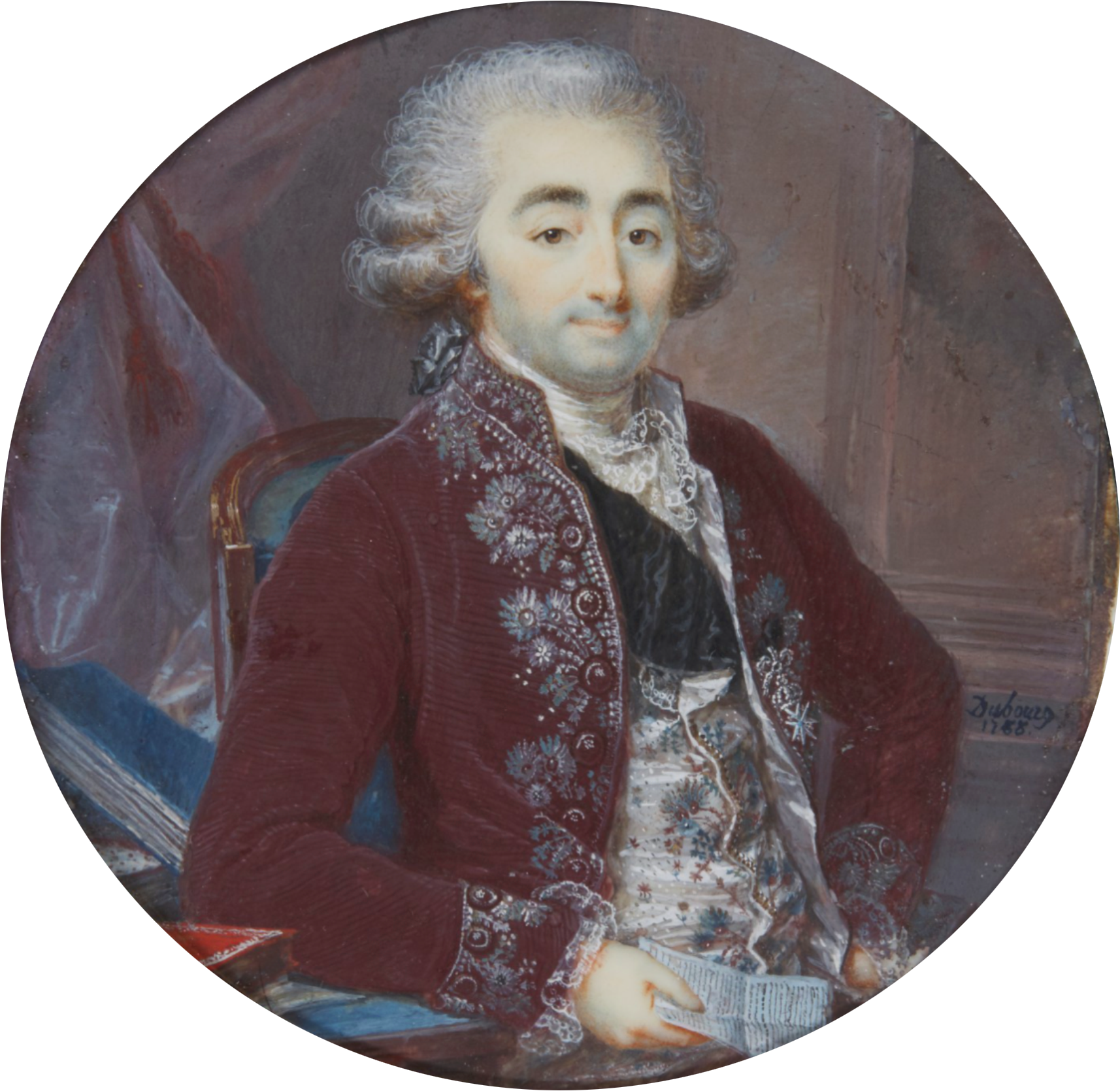
Paulin, Comte de Barral — French aristocrat, libertine, probable father of Keppel Craven.
Pierre François Paulin de Barral was born in 1745, the son of Jean-Baptiste-François de Barral, Marquis de La Bâtie d'Arvillard, and Marie-Charlotte de Chaumont-Quitry. He belonged to old provincial nobility: rich, well-connected, Catholic, military and already faintly rotten around the edges.
First intended for the Church, Paulin was released from that path after the death of his elder brother. He became a Knight of Malta, then a musketeer of the king, and eventually an officer. But military respectability was never really for him. Barral became notorious as a libertine, scandalous enough to be exiled from court and remembered later as one of the possible models for the Vicomte de Valmont in Les Liaisons dangereuses. He seduced ladies and housemaids with equal abandon, and fathered children wherever he went.
One of them was probably the Hon. Keppel Craven.
There was more than a striking resemblance between them. Both had anxious personalities. Both were charming but fastidious. And both demonstrated an immense emotional neediness that resulted in a compulsion for sexual contact.
At the time of Craven’s conception, Barral was adamantly avoiding his own wife. There is no proof that he was in London at the time, but he had motivation and means, and Keppel's mother, Lady Craven, was notoriously unfaithful to her husband. In 1783, when she separated from Lord Craven amid charges of infidelity, she took young Keppel to France. One imagines she hoped to find protection from the comte—if not for herself, then at least for the child.
The later evidence is stranger still. Keppel's own son, Augustus, had a mother who couldn’t keep him, so he was raised by a woman the world took for Keppel's mistress. Yet Victorine Derville was not his mistress. The record suggests that she, too, was Barral's child—Keppel's own half-sister, born of the same father—and that "mistress" was the fiction allowing her to raise Augustus without either secret surfacing: not the boy’s true mother, nor whose sister Victorine actually was.
Then, in 1813, Keppel began referring to her as "Mrs. Derville-Barral," and to her children as "Miss Barral" and "George Barral.” The names appeared without explanation. Yet after the peace was declared, Keppel arrived in Paris and began visiting a vague "Mr le Chevalier," whom he found "very civil" (7 May 1814). There is a particular evasiveness in the journal whenever this man appears. After Victorine Derville's death in Paris in October 1817, the Comte de Barral buried her at Allevard, in his own garden near the orangery there. Two years later, Keppel took Augustus to meet the ailing Chevalier in Paris, but was refused entry; the man was too ill (9 July 1819). Keppel never saw him again.
Paulin de Barral died in 1822, having been priest-in-training, knight, courtier, soldier, exile, industrialist, libertine, imperial baron, husband twice over, and notorious almost all the way through. Yet to Keppel Craven, he was probably something more consequential: the father he barely knew, but whose blood, name and shadow shaped his life in ways he himself may only gradually have understood.