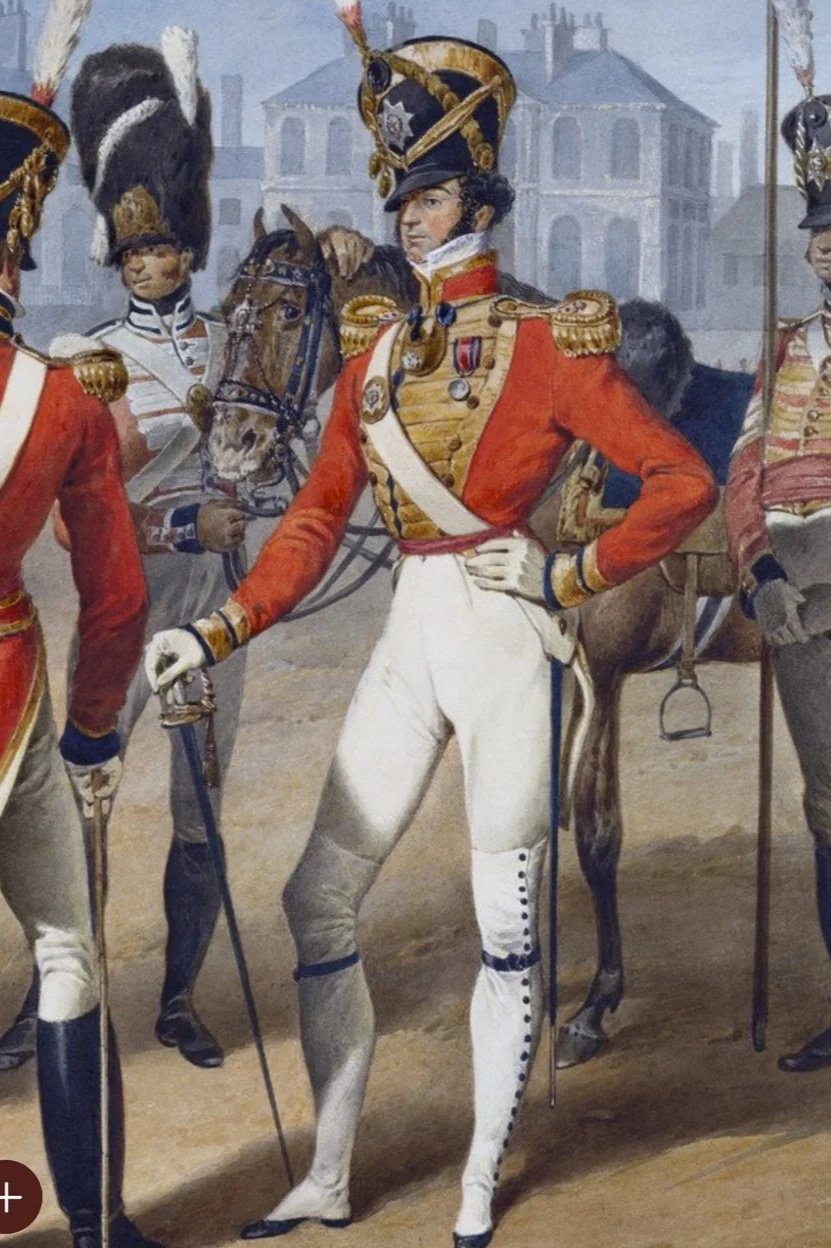
Daniel Mackinnon — British army officer and military writer.
Daniel Mackinnon was born in 1791, the younger son of William Mackinnon of the Clan Mackinnon family. He entered the army at fourteen as an ensign in the Coldstream Guards, and very quickly found himself in a world for which he’d been uniquely made.
He served in the Peninsular campaigns, from Talavera to Toulouse, and became known for a coolness that bordered on theater. One famous story had him shaving himself under fire, calmly performing courage until the men around him remembered their own. At Waterloo, he had three horses shot under him. He was wounded in the knee, but still helped defend Hougoumont, one of the crucial points of the battle.
But before Waterloo made him a hero, Mackinnon was already known to Keppel Craven. In 1810, they were all reacquainted at Lisbon: Craven, William Gell, Mary Carter and now Mackinnon, young and handsome and ready for anything. The four of them did not stay comfortable for long. Mackinnon strained the household past what Craven's journal cares to explain, and by mid-February 1811, Gell had left for England; Mary went with him, while Keppel remained behind with Mackinnon, held at Lisbon by his asthma until April.
After the wars, Mackinnon rose in the Coldstream Guards and became its historian, publishing The Origin and Services of the Coldstream Guards in 1833. He died in 1836, only forty-five years old, his health probably damaged by his Waterloo wounds. He’d been a soldier, a military writer, a man of courage, one of those glittering young officers who was as dangerous in a drawing room as on a battlefield…and yet he remained on friendly terms with Keppel Craven. Lisbon had given Mackinnon cause to resent Craven. He did not. Mackinnon forgave him, and that may say as much about him as anything he did at Waterloo.