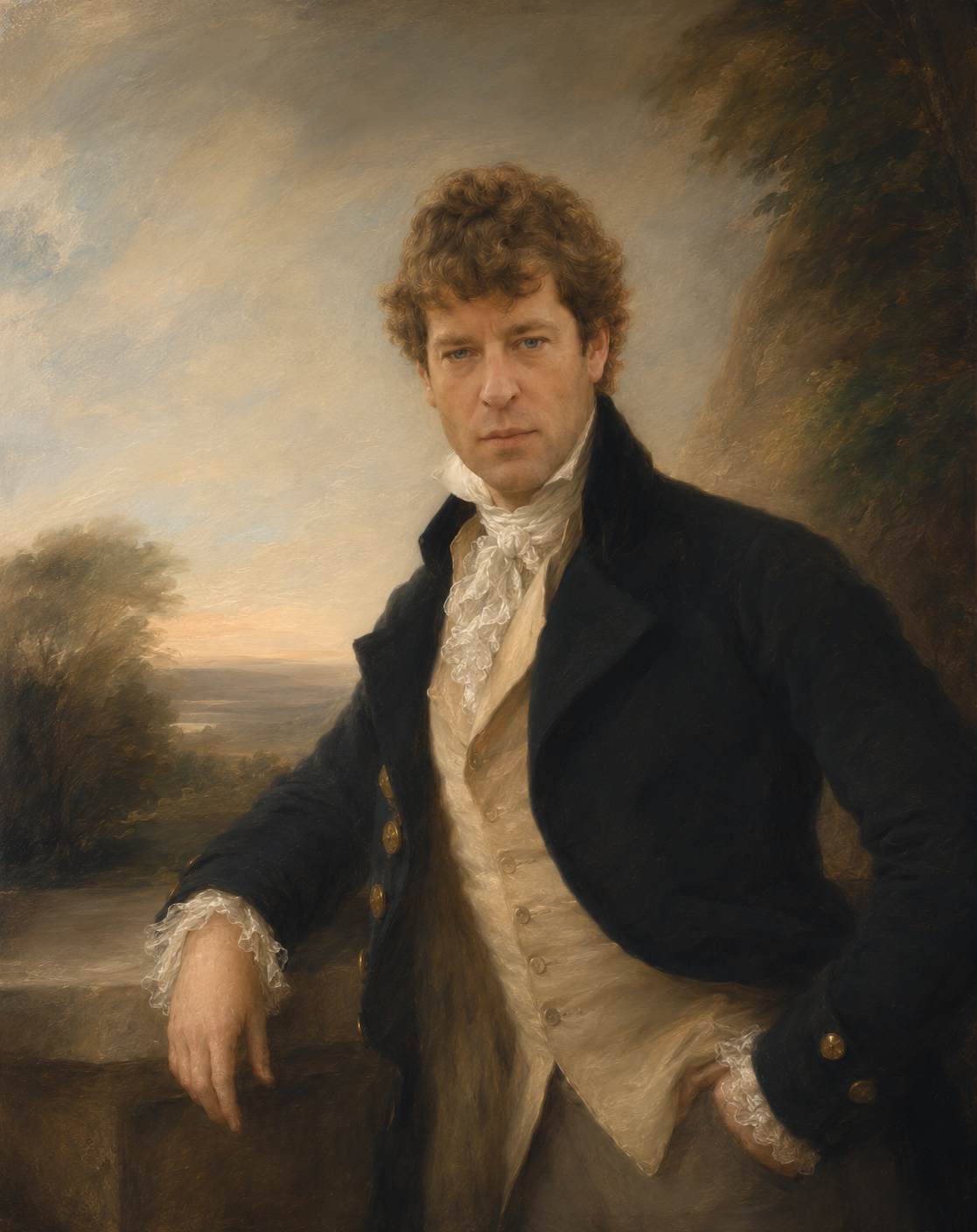
AI representation of Dr Joseph Wells since no known portrait exists.
Joseph Wells was the only son in a family otherwise crowded with strong-minded daughters. He was Mary’s favorite sibling after their baby sister, although some people described Joseph as having “odd and ill humors.” Whatever his temper, Joseph became the most accomplished member of the family. He was a Doctor in Divinity, a Fellow of the Royal Society, a Fellow of the Society of Antiquaries, a justice of the peace for Buckinghamshire, rector of Croughton in Northamptonshire, and rector of Ellesborough, of which he was also patron. In a clan of rectors and magistrates, Joseph Wells was one of the central pillars.
His own birth, however, was not quite as solid as his later position made it appear. There was later uncertainty over whether he’d been born exactly where and to whom the family claimed. Mary’s sister Elizabeth wrote in 1829 that no register of Joseph’s birth or christening could be found, although their father had been the clergyman of the relevant parish. In the 1860s, when questions arose about Joseph’s property and heirs, statements had to be taken affirming that Mary Carter and her sisters were born of the same mother and father as Joseph. The very need to say it suggests that someone had doubted it. Whether this points to adoption or illegitimacy is hard to say.
Yet if Joseph was not exactly Richard Wells’s natural son, he was certainly treated so. He became the heir, the clergyman, the man through whom the Wells family kept intact.
In 1785, Joseph married Elizabeth Francklin Burnham, daughter of the surrogate and registrar of the archdeaconry of Buckingham. They had three children, none of whom lived. This left Mary’s progeny, Dorinda and Richard Carter, unusually important to the family, for among the Wells siblings, only Mary produced descendants who survived.
After this advantageous marriage, Joseph’s wealth only increased upon the death of his father in 1804. Reverend Richard Wells left him property—possibly as many as 900 acres, or at least Joseph owned this much in the end—as well as the advowson and patronage of Ellesborough. Mary and her one married sister received a pittance. Joseph was expected to look after them…and so he did. Perhaps a little too much.
Like his father before him, Joseph became controlling. He dictated Mary’s life and the lives of her children, and the reverberations were felt long after his decease. Under Joseph’s kind of protection, a woman could be preserved, provided she remained where the family put her.
After his inheritance, with his power unchecked, Joseph’s life expanded outward. He married Mary Anne Cholwich in 1807, the first wife having died. In 1808 he leased Halton House near Aylesbury, with its acreage and sporting rights; he owned Grove Cottage at the top of the Well Walk at Cheltenham; but it was Cowley Place near Exeter (purchased 1811) that was Dr Wells’s haven. There he had greenhouses. Joseph’s first love was botany, and his second wife seems to have preserved his garden long after his death. When Mary Anne Cholwich died in 1846, the vast collection of rare orchidaceous plants was sold at auction, with some plants on the property of “immense size…and among the Heaths will be found some magnificent specimens.” There was even a printed catalogue for the sale.
Joseph Wells died in 1818, one supposes of gout, as this had bothered him for many years. Mary loved and missed her brother after he was gone, surely. But grief is not the same thing as freedom. Joseph had been brother, patron, protector and judge. He kept the family standing; he also kept it obedient. In Mary Carter’s life, that distinction mattered.