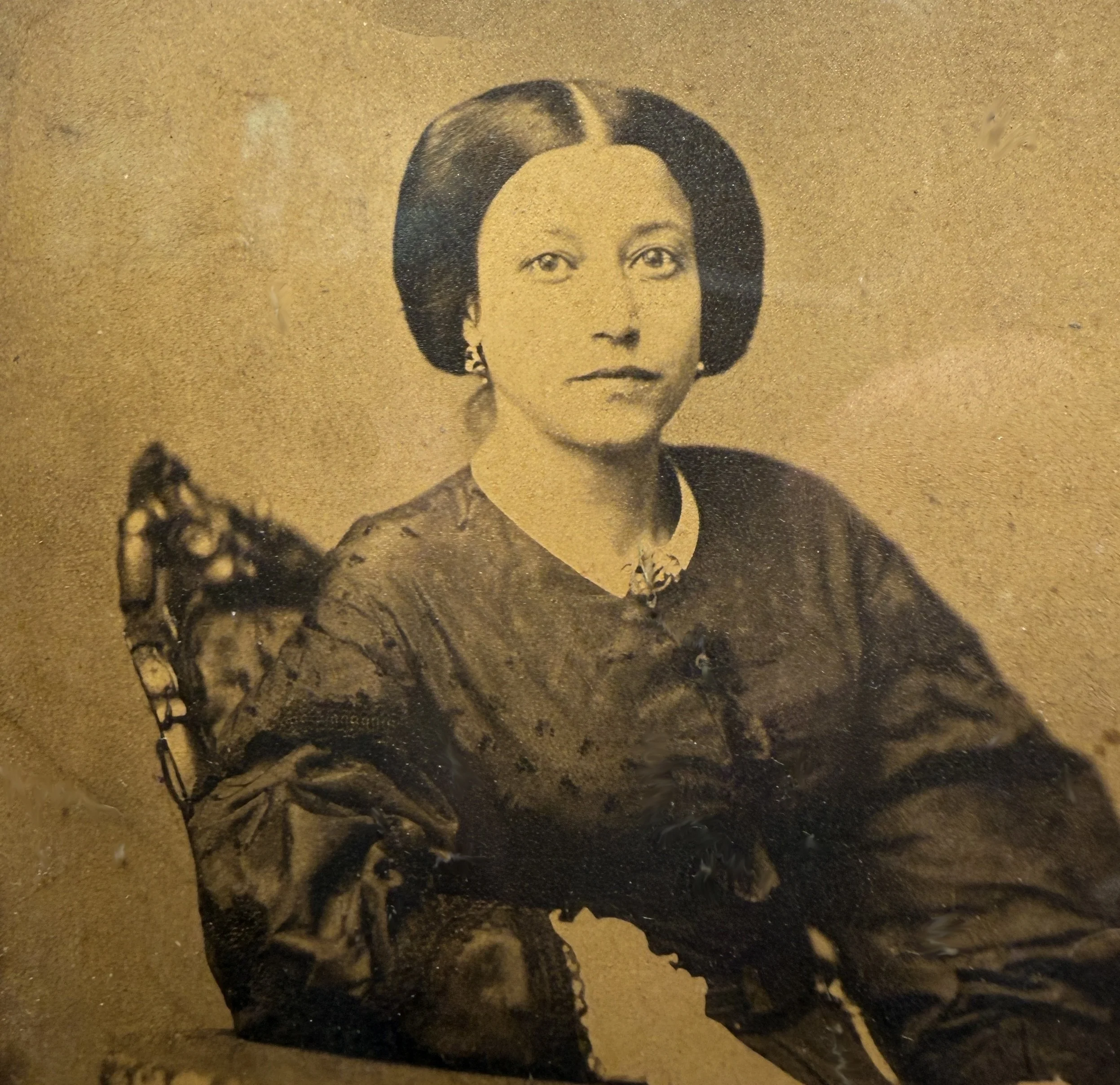
Old photo to stand in for representation of Eliza Dawson since no known portrait exists.
Eliza Dawson née Carter — daughter of Mary Carter.
Eliza Dawson was born Dorinda Elizabeth Lushington Carter in 1794, daughter of Thomas Carter and Mary Wells. Her father named her for the song that made him famous, Fairest Dorinda, but this was cast aside early. As Mary’s housemaid put it, “Her name was such a hard one, I should call her Eliza.” Her godmother was the wife of Sir Stephen Lushington, a director of the East India Company, proving that Eliza’s father—a natural son of Lord Inchiquin—moved in the highest circles of society despite being a musician and coal seller.
Eliza was six years old when her father died. She’d hardly known him. Her mother, Mary, became the secret mistress of the Hon. Keppel Craven, and as a result, lived at Naples exclusively after 1814. Eliza’s younger brother, Richard, begged to go off to India to make his riches like his papa, and so in 1812, Mary signed his papers. By 1813, Richard was dead—killed in action on the high seas was the public story, but really he’d died of a dysentery or fever.
Eliza became familiar with keeping secrets early on.
After her mother went to Italy, Eliza lived primarily with her various aunts. One expects she was also rather close to her uncle, Dr Joseph Wells, because after Richard’s death, the young girl was now the sole hope of the whole family. Dr Wells had no children. Neither did Eliza’s aunts. She stood to inherit at least 900 acres, so when she announced her engagement to marry her cousin, Dr Wells had something to say about the match. He said no. He even threatened to disinherit her, which he did—vehemently—when Eliza went through with the marriage anyway, just after her twenty-first birthday.
Her uncle had been right. Although Eliza loved Robert Dawson, and ultimately gave him nine living children, eventually Dr Wells’s concerns were vindicated. We don’t know exactly when Robert’s mental illness first became evident. He was extremely religious—more so than the whole Wells clan, all clergymen. Probably familiar with his mother-in-law’s sinful lifestyle, he took it upon himself to declare her deceased. She wasn’t. Now Robert was a surgeon of some standing in High Wycombe at the time. His house was adjacent to the church and cemetery, so it would have been a simple thing, to say Mary Carter had suddenly died in his house. Who would doubt him? And Mary, her daughter and sisters couldn’t dispute it. To do so would reveal Robert’s illness, which would bring shame on the family.
By this action, Robert Dawson got Mary’s entire London bank account, probably worth several hundred pounds. Mary herself was at Naples, completely unable to prevent the catastrophe.
In 1830, we find Robert mentioned in the Bucks Gazette. He was attending an anti-slavery meeting where he put forth a motion “energetically” (and out of turn) that those assembled would stop everything to conduct a prayer. By 1832, he’d been admitted to Northampton General Hospital. At this point, he must have been unbearable to live with. Eliza left him. That summer, Mary Carter and Keppel Craven came to London, where Craven generously purchased an annuity on his own life, and made sure by legal action that only Eliza received the payments.
By 1833, Robert had been deemed “well.” He set up a surgical practice in Long Buckby, Northampton, while Eliza stayed behind in High Wycombe with the children. She told all her acquaintance that her husband was in Scotland—just as she’d lied about her mother’s whereabouts until her supposed death—and from then on, the couple lived apart.
This did not stop Robert from threatening her.
In and out of hospitals, and finally locked up at Bethlem, Robert Dawson was a constant source of worry for Eliza. Yet if she suffered maritally, she did eventually regain the property of her uncle. Those 900 acres had passed to a relation, but in 1847, that relation had died, leaving Eliza in a position to fight for reclamation of her rights. She won back the land. She became a rich woman…and sold most of it by auction not long after Robert’s death in 1861.
Eliza Dawson died in 1880 and was buried in a common grave in Brompton Cemetery, without marker or stone. No one knows what happened to all her money. It was a brutal ending for the daughter of Thomas Carter and Mary Wells: born with music in her name, trained from childhood in secrecy, heir to nearly everything, mother of nine, and finally left with nothing to say she’d ever lived.