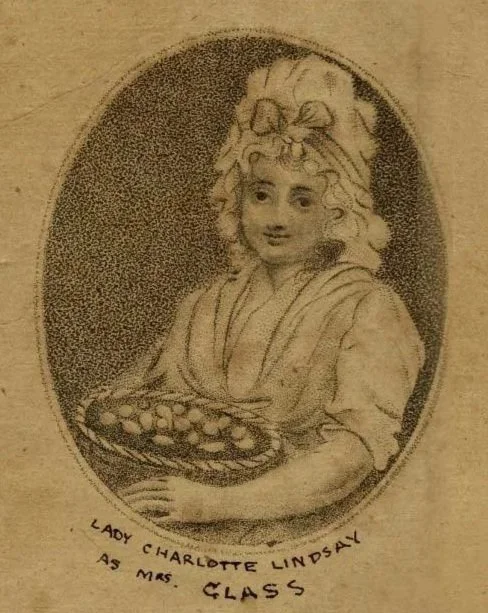
Lady Charlotte Lindsay, drawn by the Hon. Richard Keppel Craven, from Sir William Gell’s papers/notebook, British School at Rome Digital Collections. Reproduced from BSR Digital Collections for scholarly/educational use.
Lady Charlotte Lindsay née North — Lady-of-the-Bedchamber to the Princess of Wales, daughter of Lord North.
Lady Charlotte North was born in the Prime Minister’s residence at Downing Street on 13 Dec 1770. She was the youngest child of Frederick North, 2nd Earl of Guilford—better remembered as Lord North, the prime minister who lost America. During the Gordon Riots of 1780, Charlotte was bundled out of No. 10 at two o’clock in the morning. She was conveyed with her family through the Park to the Horse Guards, and once there, she was laid, wrapped in blankets, on the table in the guard room in the midst of the officers, it being the safest place. “And it was such fun,” she said afterwards, “that I have ever after had rather a liking for insurrections.”
Charlotte thus came into the world with excitement, rank and a love of politics. It was the latter, as well as her wit and amiability, which likely drew Mary, her friend. They were five years apart. They probably met at Bath, where their families often wintered, or at Margate, where Mary’s father owned a house. Either way, by 1794, Mary Charlton (alias Mary Carter née Wells) was mentioning “Lady Charlotte and her dear friend” in the beginning of her book, writing that, having waded through its dedication, Charlotte was probably complaining, “Oh heavens! Pass over that nonsense and let us get at the story.”
No more “Charlotte” of an exclamation could be devised.
Lady Charlotte North was famous for her wit. One anecdote has her quipping, upon being complimented, “I dare say it’s true, the bloom of ugliness is past.” On coming late to dinner, she excused herself on account of the macadamable state of the roads. It is no wonder she befriended Sir William Gell, too, for the pair of them, with all their combined humor and geniality, must have made a party wherever they went. She and Gell met at Kensington—exactly when, nobody knows—and remained lifelong friends. At one point, the Princess of Wales banished her out of jealousy, for Her Royal Highness had designated Sir William her own. Gell even gave Charlotte a ring with a winged cupid on it.
Her relationship with Gell was not serious, however. Having married Lt.-Col. John Lindsay in 1800 (and then largely separated from him shortly afterwards), Charlotte was the model of chaste behavior. This made her a good candidate for Lady of the Bedchamber. She served the Princess of Wales as such—sporadically—from 1808 until 1817. Thus Charlotte was part of the household (for a time) with Gell, Keppel Craven, Mary Carter and others during Caroline’s tour of 1814. She probably witnessed the indiscretions between the Princess and her courier, the notorious Bergami. Charlotte certainly knew Caroline’s scandalous nature.
So it was all the more remarkable that, when George IV tried to destroy Caroline through the Pains and Penalties Bill of 1820, Lady Charlotte became one of the Queen’s most important witnesses. She testified in Caroline’s favor. She was called twice, pressed again and again upon the same dangerous points, and examined until she cried. The prosecution plainly hoped to rattle her. They didn’t. Charlotte walked a fine line between the truth—Caroline’s indecent behavior—and what she’d seen with her own eyes. Charlotte’s fortitude gave the public exactly what it needed: a virtuous Englishwoman, visibly distressed, yet still unable to condemn the Queen. Alongside Gell and Craven, Charlotte helped turn the King’s case from accusation into overreach.
Lady Charlotte survived the Queen by many years. She divided her time between Agnes and Mary Berry (her near-constant companions), and various family. She had a house in Green Street in Mayfair, and it was here that she died in 1849. She left little obvious fame behind her: scores of letters to Sir William Gell, a Paris journal, scattered references in political memoirs. Yet for Caroline, Keppel and Mary, she mattered. Upon learning of her death, Keppel wrote in his journal, “Lady Charlotte Lindsay, my oldest and most valued of female friends, died in London on the 25th of last month.” One can almost feel his heartache at the news.