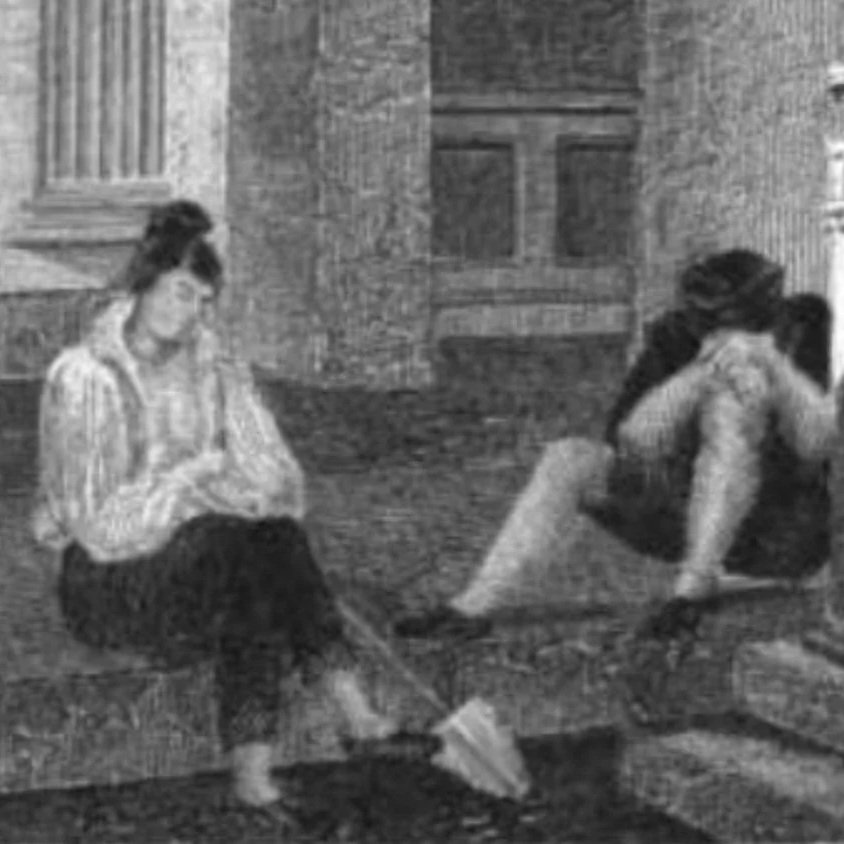
Lady Mary Deerhurst in her pantaloons with Sir William Gell, hiding his face, as drawn by Gell in Pedestals on the Forum.
Lady Mary Deerhurst — Archaeology enthusiast, equestrian, later Lady Coventry.
Lady Mary Beauclerk was born on 30 March 1791, the daughter of Aubrey Beauclerk, 6th Duke of St Albans, and Jane Moses. She came from a family whose rank was old, illegitimate in origin, theatrical by inheritance and never quite dull. A Beauclerk was, after all, descended from Charles II and Nell Gwyn; respectability sat upon the name, but not too heavily.
In 1811, Mary eloped to Gretna Green with George William Coventry, Viscount Deerhurst, later 8th Earl of Coventry. He was a widower, a politician, the heir to Croome. Apparently his siblings were much more appealing, because shortly after the wedding, Lady Mary pursued first one younger brother of the viscount, then the other. Although George was no saint, he took offense at his wife’s cheating. Still the couple didn’t part. Then in 1818, the Coventry family discovered evidence of an illegitimate child secretly born to Lady Mary and smuggled away in a parcel. The marriage effectively collapsed. The Deerhursts separated.
It was around this time that she met Sir William Gell.
Lady Mary liked archaeology. She had a large fortune. She also had the unfortunate talent of becoming important rather too quickly. By 1822, the duke’s daughter with the roving eye, unpolished manners and plentiful income had made herself impossible to ignore at Naples. She adored horseback riding—Mary Carter rode with her, regardless of Lady Mary’s penchant for riding astride. She appreciated history—Gell took her to Pompeii, where she dug up antiquities with glee. Gell even drew her into his Pedestals on the Forum, where she is shown in her trousers, a spade at her side, while Gell hides his face for anonymity and Craven has his back turned. Of course Mary Carter is not pictured.
Lady Mary Deerhurst—eventually Lady Coventry, or Lady Godiva, as Gell was fond of calling her—became a regular presence at his little salon. After Gell’s death, she continued a firm friendship with Keppel and Mary, and even with Keppel’s secretary. She maintained these relationships right to the end. When Lady Mary died at Naples in 1845, Craven, upon learning the news, wrote in his journal, “Much overcome by it.” Given how hard he’d once found it to absorb Lady Mary into their circle, this tenderness is striking.
But then, few people in Keppel Craven’s life were unloved by him.