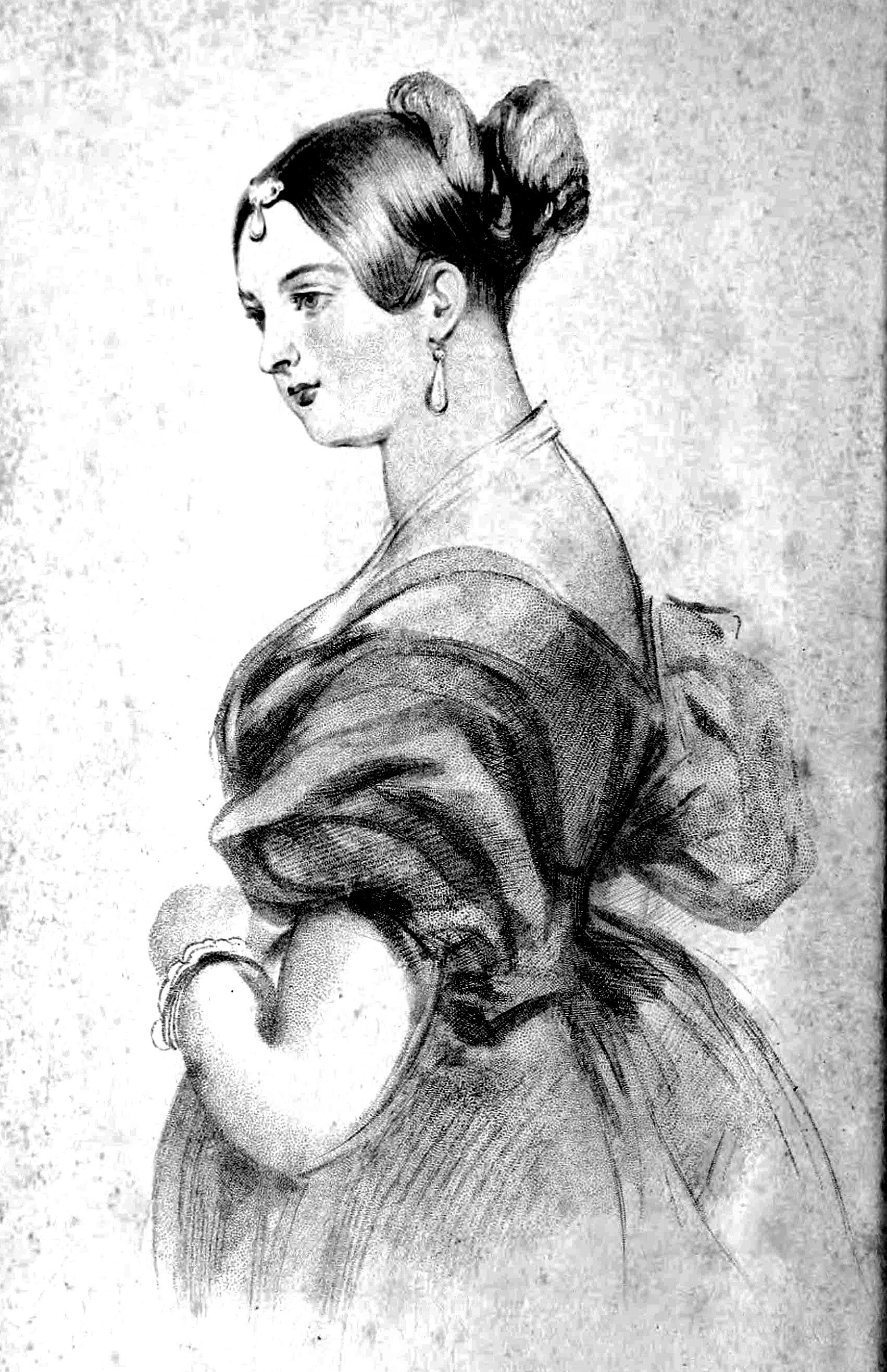
Marguerite Gardiner, Countess of Blessington — Irish writer, journalist, and literary hostess.
Margaret Power was born in 1789 near Clonmel, County Tipperary, the daughter of Edmund Power and Ellen Sheehy. Her childhood was not happy. Her father was violent and poor, and while still a girl, Margaret was forced into marriage with Captain Maurice St. Leger Farmer, a drunken army officer who soon made her life miserable. It is thought that he beat her, and possibly raped her. She left him within months. At first she went home to her abusive father, but soon she found another protector, a Captain Jenkins—not a love match, but better than the alternative. She remained with Jenkins for six years while Farmer pursued his dissipation.
Eventually, luck stepped in. Farmer fell out a window. He didn’t survive. After his death, Margaret immediately married her new protector, Charles Gardiner, Earl of Blessington. This man couldn’t have been a more accommodating suitor. She called him “the most gallant of all gallant husbands,” and a portrait of him shows an effeminate face suggesting softness rather than command.
Thus Margaret became Marguerite Gardiner, Lady Blessington: rich, indulged, painted by Lawrence and launched into the fashionable world.
In 1822, the Blessingtons left England for the Continent. On the Rhône they met Count Alfred d’Orsay, a dazzling young French officer. Lord Blessington adored him (maybe too much); Lady Blessington admired him, and d’Orsay soon became part of their family. He accompanied them into Italy. There Marguerite met Byron and gathered the conversations that would later be published to cement her literary fame. She also met Mary Carter—introduced, probably, by Lady Minutolo—and it was this friendship, and Marguerite’s with Sir William Gell, which bonded her to the Craven household. Mary and Marguerite shared a love of writing as well as something else: each was part of a triangular domestic arrangement, for whether d’Orsay was her lover or her husband’s, there were three in the Blessington marriage.
It was something that endeared her to Keppel Craven because, whatever was happening in the Blessingtons’ bedroom, the similarities must have been obvious to him: a husband devoted to another man, a wife who loved them both. It made Marguerite not just a friend, but evidence—that a woman could know, and choose to stay.
Lord Blessington died suddenly in 1829, leaving confusion, debts, and a much-reduced income. Marguerite returned to England with d’Orsay. He had by then married her stepdaughter, although he remained passionately attached to Marguerite. As before, it was not readily apparent who was sleeping with whom. Consequently their household scandalized respectable society. Even so, Gore House became one of the most famous salons in London. Writers, politicians, artists, actors and exiles flocked to Lady Blessington’s drawing room, including Disraeli, Dickens, Landor and Bulwer.
To support this brilliance, she wrote constantly. She produced novels, travel books, memoirs and annuals, the last including contributions from Mary, Keppel and Gell. Yet in the end, extravagance outran talent. Creditors closed in. Gore House and its contents were sold, and Lady Blessington fled to Paris to join d’Orsay. She died there soon afterwards in 1849, still loved by the man who’d married Lord Blessington’s daughter to please him, and who had never once loved Marguerite less because of it. It was the same arithmetic Keppel and Mary had built their whole lives around: love, unevenly shared, somehow enough for everyone inside it.