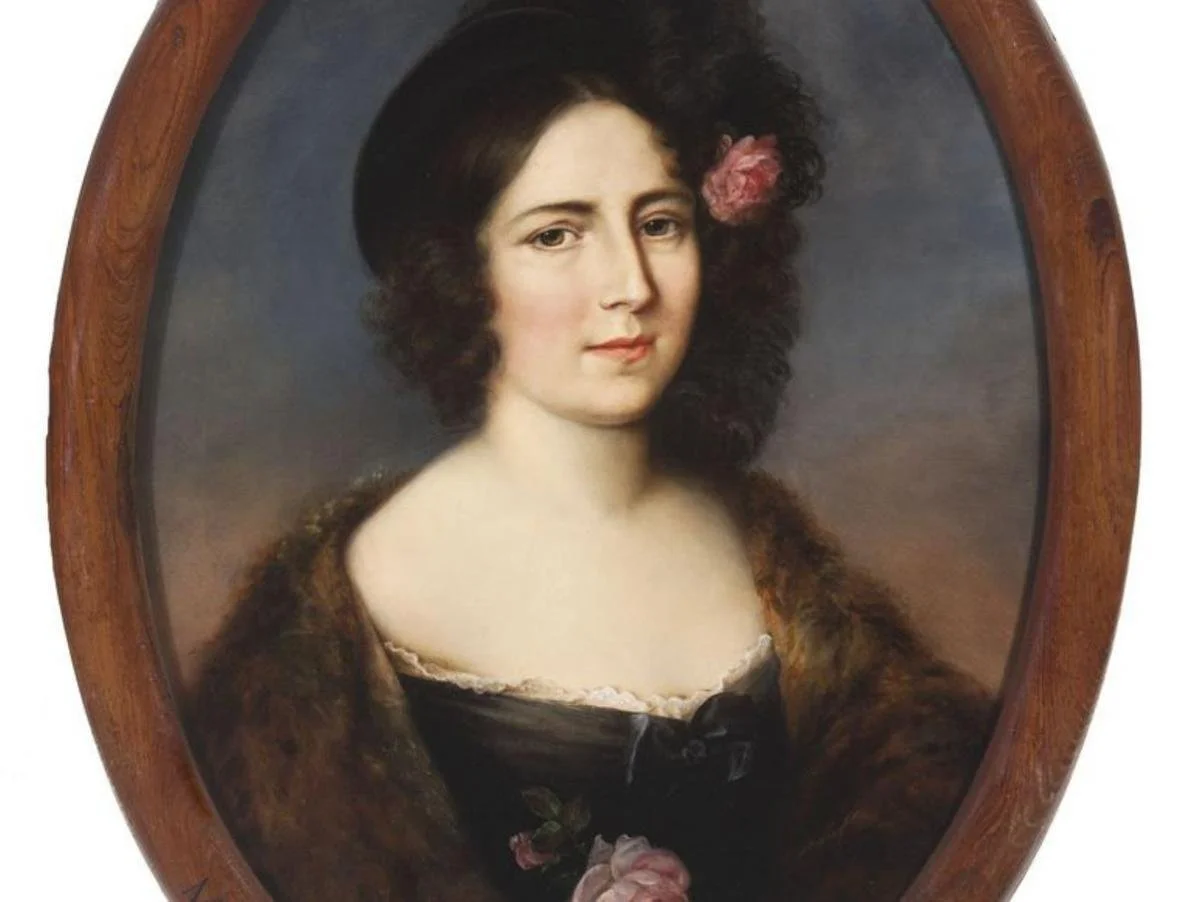
Matilde Capece Minutolo — Marchesa della Sonora, Spanish wife of Murat’s Field Marshall.
María Matilde de Gálvez y Saint-Maxent was born in New Orleans in 1778, the daughter of Bernardo de Gálvez, the Spanish hero of Pensacola and later Viceroy of New Spain, and Felicité de Saint-Maxent, a French Creole woman from one of the richest and most powerful families in Louisiana. Thus Matilde was Spanish by allegiance, American by birth, French by blood and Neapolitan by marriage. She belonged, from the beginning, to a world between worlds.
Her father died when she was a child, but he left behind one of the great names of the Spanish empire. The Gálvez family had risen through service, war, administration, patronage and enormous Bourbon favor. In time, after the deaths of other heirs, Matilde inherited not only money but titles: she became Condesa de Gálvez and Marchesa della Sonora.
In 1795, Matilde married Raimondo Capece Minutolo, son of the Prince of Canosa, a Neapolitan nobleman then serving in Madrid. He would eventually rise to the rank of field marshal. Through him, Matilde entered one of the oldest families in Naples. Through her, the Capece Minutolo family acquired Spanish money, Spanish rank, and a transatlantic magnificence that never quite became ordinary Neapolitan nobility.
Their life was not simple. Raimondo first served the Bourbon king. When the French came to Naples, he followed the royal family to Palermo, leaving Matilde behind. She kept faith, at first, with the exiled court. But her correspondence with the Bourbon queen was opened and read; Matilde was denounced by Caroline Murat; and she was confined for a time in a monastery along with her daughters and her Mexican maid.
Eventually Matilde was released, and permission granted to join her husband in Sicily. Bourbon loyalty, however, got them nothing. Raimondo had never been amply rewarded, their sacrifices not appreciated by the Bourbon King. Thus Murat, needing skilled officers, made an offer to Raimondo. He accepted it, and returned to the Neapolitan army. He transferred his loyalty from the Bourbons to the French, and then, after Murat’s fall, back again. Such changes were not uncommon in the age of Napoleon, but they had consequences. After the Restoration, the family was left slightly aside: too Bourbon for the French, too French for the Bourbons.
Matilde answered exclusion by making a world of her own. Her house became less a court than a cultivated refuge: musical, diplomatic and just beyond the center of official favor. Her adopted son, Giuseppe Balducci, composed operas for herself and her three daughters to sing. She befriended all sorts of aristocratic visitors to Naples…including Mary Carter and Keppel Craven.
Mary and Matilde became close friends. They shared a love of animals. Both were singers. Both had similar temperaments—defiant, or what Matilde’s daughters called “hot Spanish blood”—and as a result, Keppel Craven was drawn into her orbit. She was everything he admired in a woman, so that, when Matilde was widowed in 1827, it was natural that he would wish to assist her. She had financial worries. Craven gave her money. Moreover, after several summers in which the Minutolos lived in his villa at Posillipo, Craven left the property to the family in his will.
Matilde herself died after a short illness and a lung inflammation in 1839. She’d been at Málaga, dealing with her Spanish affairs. Her daughters returned to Naples as orphans. Keppel Craven looked after them almost as a father, and indeed, his own son and daughter-in-law treated the girls as sisters, so that the Minutolos were with the Cravens right until the end. Matilde had spent her life negotiating what she was owed by kings, but ultimately, it was Keppel Craven who paid it.