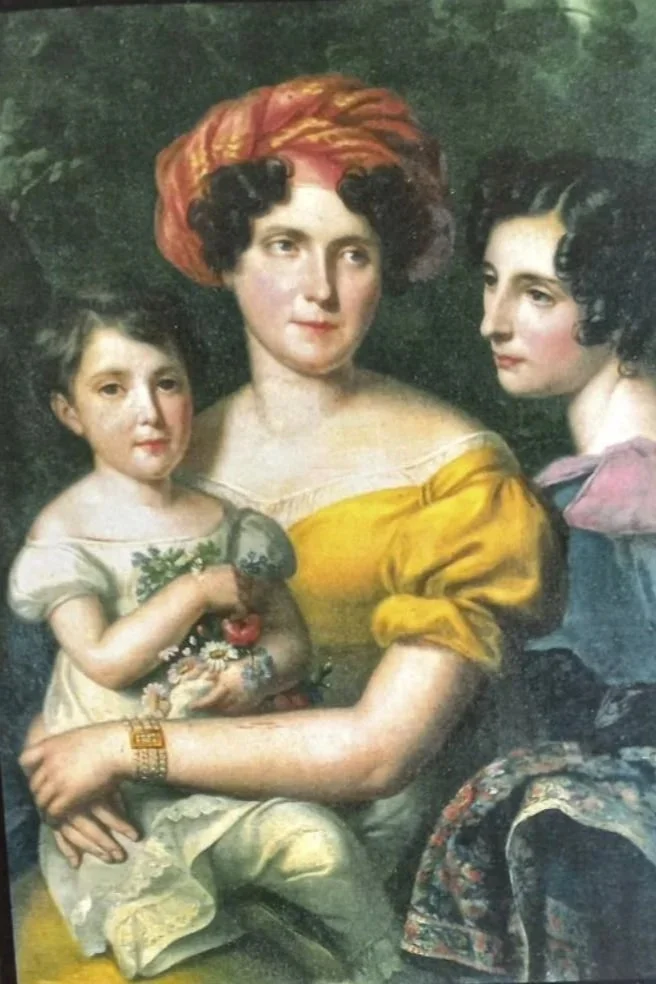
Pauline de la Ferronnays is shown on the right with her mother and little sister Olga.
Pauline de la Ferronnays — French Catholic writer, diarist, wife of Augustus Craven.
Pauline Marie Armande Aglaé Ferron de la Ferronnays was born in London on April 12, 1808, the daughter of Auguste, Comte de la Ferronnays, and Marie-Charlotte-Albertine de Sourches de Montsoreau. Her family belonged to the old French nobility. They were Catholic royalists, and therefore displaced by Revolution but restored by the Bourbons. Pauline was born in exile, but raised in expectation: of rank, faith, duty and sacrifice.
Her father’s career gave Pauline connections. He served as ambassador at St. Petersburg, became foreign minister under Charles X, and was later sent to Rome. Pauline grew up among courts, diplomats, priests, writers, and devout thinkers, but the deepest force in her life was not society. It was religion. Catholicism was everything to her.
After the July Revolution of 1830, the la Ferronnays family moved to Naples. There Pauline met Augustus Craven, then attached to the British Legation: English in name, French in upbringing, he was Keppel Craven’s son. The couple married in 1834.
Keppel soon found that he, too, was fond of Pauline, for they both loved the theatre, acting, literature and gardening. Keppel wrote to her regularly, often describing pretty children he’d seen, or books that he’d read, or the slugs in his flower pots that had eaten his flowers.
The marriage sadly produced no children, but it resulted in a life of letters, devotion, anxiety, travel and dependence. Pauline followed Augustus through diplomatic postings and private uncertainties: England, Lisbon, Brussels, Stuttgart, Naples, Rome, Paris. She loved him, defended him, suffered with him, and was often obliged to make literature do what fortune had failed to do. In middle age, money made writing necessary. Faith made it meaningful.
Pauline’s great work was Le Récit d’une sœur, published in 1866. It was drawn from family papers, letters, journals and grief. At its heart was the story of her brother Albert and his wife, but the book was more than family memorial. It transformed the la Ferronnays circle into a kind of Catholic holy family: refined, loving, doomed, and sanctified by early death. Readers adored it. It made Pauline famous, and it made private sorrow into public edification.
Augustus died in 1884. Pauline survived him by seven years, busy almost to the end with articles, memoirs and fiction, until paralysis deprived her of speech. She died in Paris on April 1, 1891. But her death was not the end of her significance to this story. Keppel Craven’s journals, letters and portraits, having passed to her via Augustus, were bequeathed to her nephew, the comte de Mun, and from there, eventually, the lot ended up being sold. This is how Keppel’s papers came to the Catholic Institute at Paris. And this is how—should the portrait by Henri Grévedon actually be her—Mary’s likeness came to hang in the musée national Magnin in Dijon.