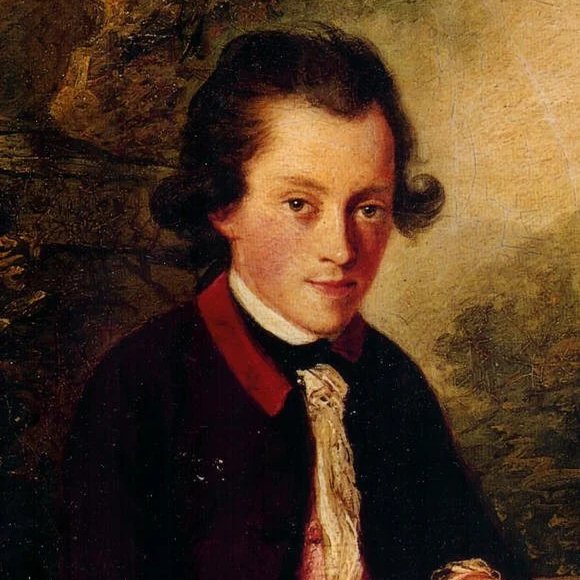
Thomas Carter — Singer, coal merchant, first husband of Mary Wells.
Thomas Carter was born in County Cork, Ireland in 1767. He was widely believed to be the natural son of Murrough O’Brien, 5th Earl of Inchiquin, while his mother may have been Abigail Aston of Beaulieu, near Drogheda, although this is uncertain. The more respectable story made him a poor Irish boy of musical promise lifted out of poverty by a generous nobleman. Either way, Inchiquin treated him like a son.
Thomas grew up between Rostellan, Cliveden and the musical world Inchiquin opened to him. He sang beautifully as a boy, well enough to be noticed at Cloyne Cathedral and sent abroad for training. In 1781, Inchiquin paid for him to go to Naples, where Sir William Hamilton and Lady Hamilton took him up. The plan was musical education; the result was something less disciplined. Thomas sang for company, for parties, and even for the Queen of Naples, until his voice broke at precisely the wrong moment. He recovered part of it by learning to sing falsetto, but the dream of a grand Italian musical education was over.
Back in England, Thomas returned to Inchiquin’s house, and to the neighborhood of Cliveden and Taplow Court. It was there, probably as a young singing master, that he met Mary Wells of Cookham and Ellesborough. She was older than he was. Mary was better born in the ordinary English sense, the daughter of a rector who had every reason to distrust a short Irish musician with uncertain parentage and no secure profession.
Mary loved him anyway.
Before she could have him, however, he went to India. Thomas sailed for Calcutta in 1786, where William Hickey took him in and introduced him to society. Thomas became useful very quickly: singer, musical director, teacher and charming little Irishman with a voice people remembered. He made money from concerts and patrons; rode Hickey’s horse; took a Hindustani mistress; fell hopelessly in love with his pupil, Miss Prince; proposed; was refused; found his health damaged by despair; and finally came home richer, sadder and probably more interesting than when he had left.
He returned to England in 1789 with several thousand pounds. Some of it he lent to Lord Inchiquin, which says much about the relationship. In time, though, he got it all back and set himself up as a merchant, using Inchiquin’s connections and his own manners to sell coal.
His goal was respectability. His prize: Mary Wells. He danced with her all night at his sister’s house at Cliveden. Soon he proposed marriage…and was positively refused by Mary’s father, who wanted his daughters at home. This didn’t deter Thomas. He arranged a runaway match. Mary pretended to stay over at Lady Orkney’s, but in reality her bridegroom met her in a chaise. Off they went to London, and Mary’s maid later described the aftermath: “Lady Young came very early in the morning and I let her in. She asked if my mistress was up. I told her she was not. She then went to the bottom of the stairs and called out to her, ‘I have some news for you. I congratulate you that Miss Mary was married yesterday and I have seen the marriage in the paper.’”
They were wed at St. Andrew’s, Holborn in 1793. Afterwards came two children. For a few years, the marriage was a happy one. Thomas sold coal and wine in Thornhaugh Street. He sang at clubs and private parties—even for the Princess of Wales—and moved among musicians, lawyers, artists and men who drank too much. He belonged to the Harmonists’ and the ad Libitum Societies where he sang with Samuel Maynard, who introduced him to Keppel Craven, who in turn befriended Mary…with surprising consequences.
Then Thomas’s health began failing. In India he’d suffered “attacks of liver,” but now, in London, the drinking culture of musical societies derailed him. The entanglement with Keppel affected him deeply, and by 1800 Thomas was dangerously ill.
He died on 8 November 1800 at his house in Thornhaugh Street. He was only thirty-three. For Mary Carter, he’d not been merely a first husband. Without him, she never would have known Keppel Craven. Absent Thomas’s melancholy end, the story would have turned out differently indeed. He was the romance before the wreckage, the singer whose claim came before the Honourable’s and never quite ceased to trouble it. Keppel Craven would become the great story of Mary’s life, but not as a clean second chapter because, bound up inextricably, Thomas had been the first.