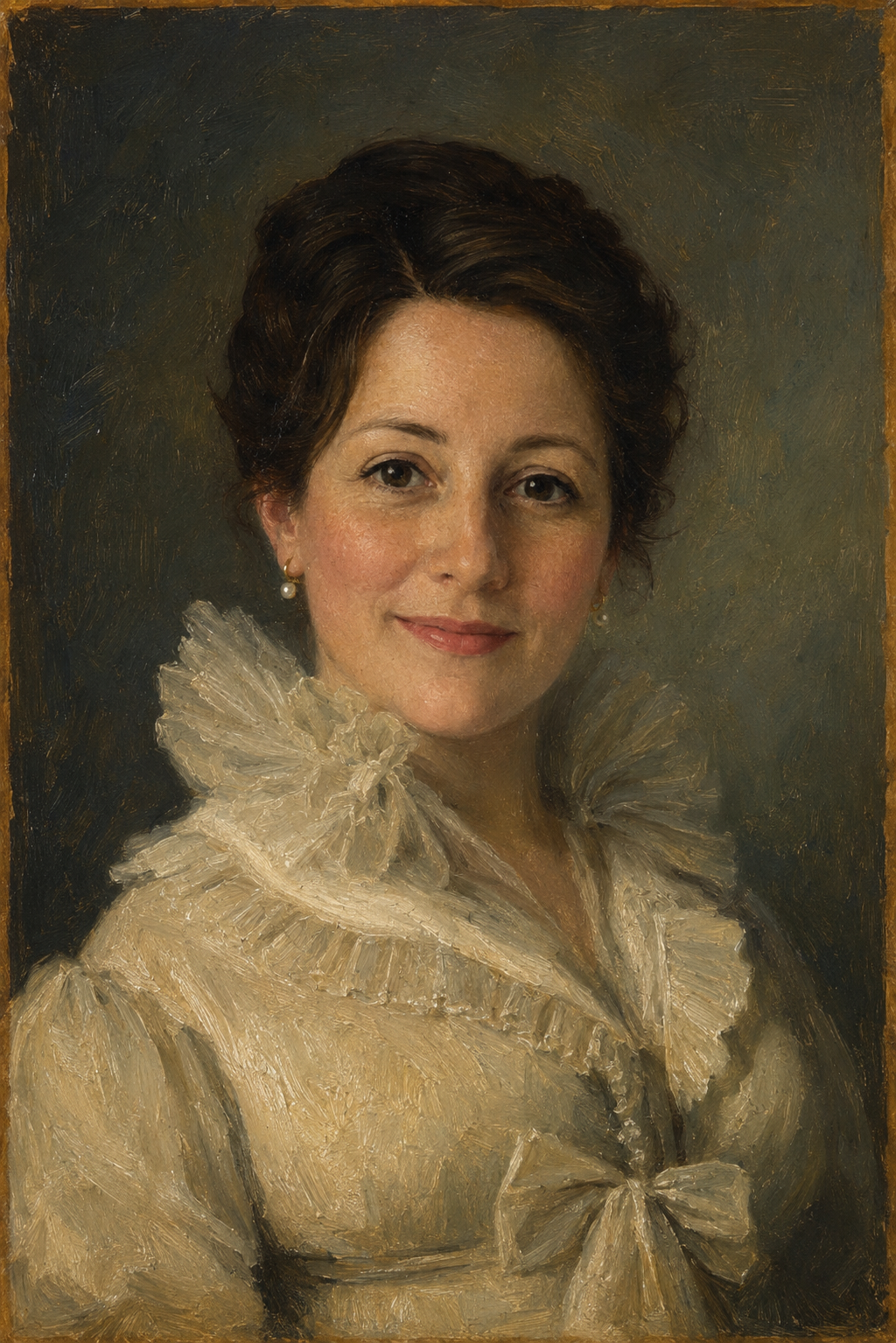
AI representation of Victorine Derville since no known portrait exits.
Victorine Derville — French courtesan, brothel owner and half-sister of Keppel Craven.
Victorine Derville slips into the record with a name that itself may have been a fiction. She was born in France in approximately 1763, probably the first-born child of the comte de Barral. The comte would have been just seventeen years old, set loose upon Paris to feel his oats—this many years before the liaison producing Keppel Craven. One imagines Derville’s mother as a similar society lady, or an opera dancer. The truth is that her parentage is murky at best. We know only of Barral because, in Keppel Craven’s journal, after years of recording her as “Derville” or “Aspasia,” in 1813 he begins referring to her as “Mrs Derville-Barral.” No explanation. No marriage. Indeed, the comte was in Paris at the time.
It is not known how or when she came to London in her youth. Yet come she did. Derville had three children out of wedlock with Thomas Clarke Jervois, High Sheriff of Hampshire. Derville’s two girls died. The son, born in Marylebone in 1789, survived to become Captain William Clarke Jervois, R.N. Eventually Derville quitted the boy’s father—he was abusive and went mad—and she escaped to the protection of Lord Maynard next. After him, the Duke of York kept her. She gave the duke two living children: Georgiana Derville, who later befriended Chopin, and George Gosling, who also became a captain in the Royal Navy.
By 1790, Derville owned a house of her own. By 1795, she’d traded it for a larger one, presumably supplemented, or purchased for her, by the duke. Still, in 1803, His Royal Highness became smitten with Mary Anne Clarke. At the time, she was Keppel Craven’s girl, but Clarke did a little trading up of her own. She seduced the Duke of York. His Royal Highness dropped Derville.
This was the end of her courtesan career and the beginning of Derville’s self-respect. She declared her independence from men. She set up shop in Golden Square as a brothel—separate from her home for the sake of discretion—and began providing women to the likes of Lord Byron and eventually the Duke of Wellington, for whom Derville kept a running bill.
This business of hers—where souvenirs from clients were a hazard of the trade—provided the perfect cover to raise Keppel Craven’s child.
That child was Augustus. Born where he could not safely remain, he was raised by Derville as if he belonged to her. Keppel Craven didn’t know. At first he seems not to have even guessed the boy was his. It took Craven five whole days to visit Augustus after the birth. When he did, there was no particular emotion in his journal: on that day, coming into town, he stopped at his brother’s; deposited his horse in a livery stable; went home; dressed; returned to Lord Craven’s; and finally, in the evening, visited Derville. “The child very fine” was all he had to say…and then he ran off to Benham to go hunting, never mentioning the boy again until 1809.
Victorine Derville died at Paris, where she’d gone shortly before. She was only fifty-four. After her death, the Comte de Barral buried her at Allevard, in his own garden near the orangery. That burial matters. Men did not usually bury former mistresses in their private gardens.
But a father might.